How to Make a Peptide Nasal Spray: A Step-by-Step Guide for Semax, Selank & Other Cognitive Peptides
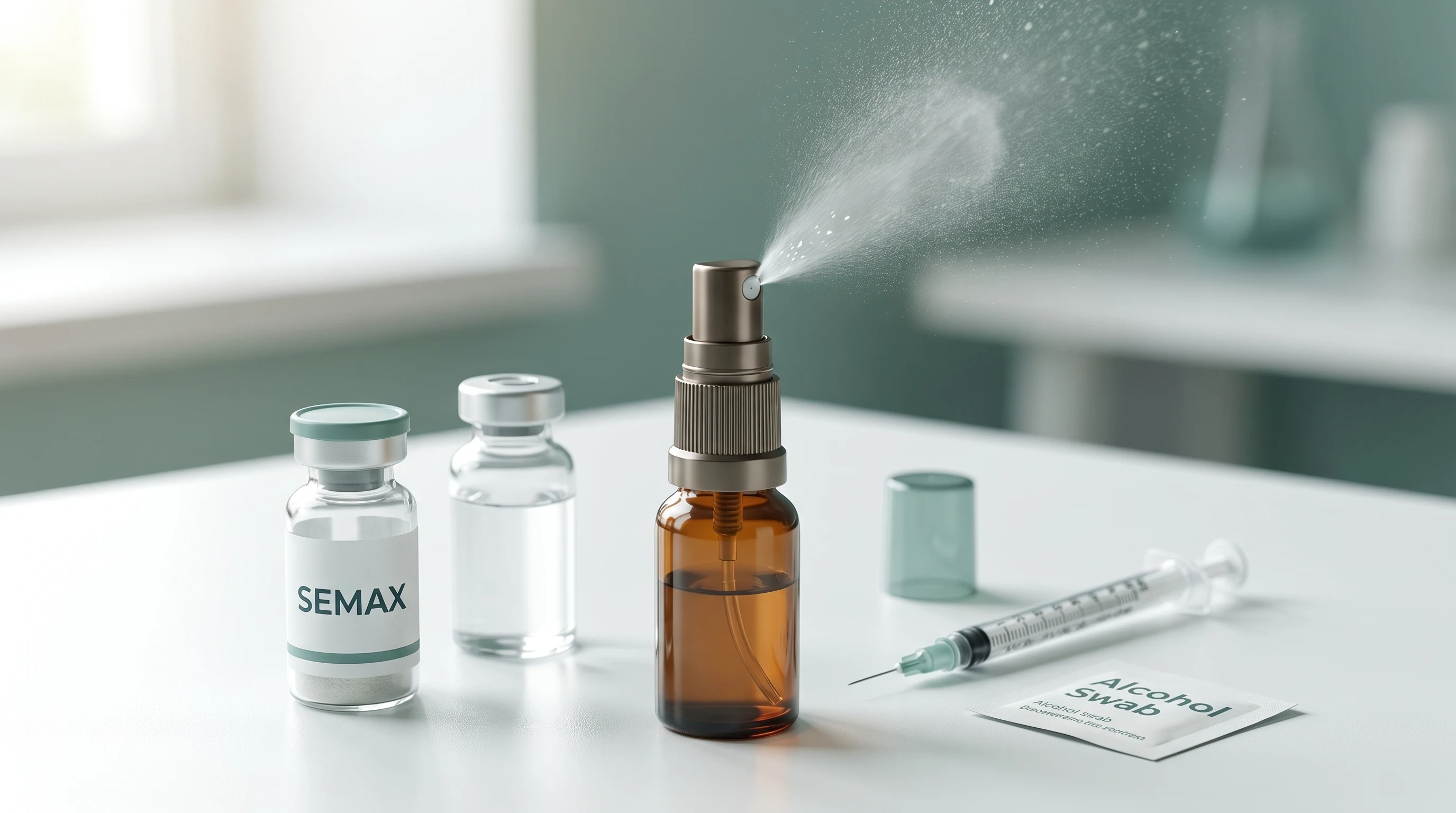
A peptide nasal spray is a reconstituted peptide solution transferred into a metered-dose nasal pump bottle so it can be delivered through the nasal mucosa instead of by injection. For cognitive peptides like Semax and Selank, the intranasal route is not just a needle-free convenience — it is the primary research route. Nose-to-brain delivery via the olfactory and trigeminal nerve pathways bypasses first-pass metabolism and shuttles peptides into the central nervous system far faster and at higher relative concentrations than subcutaneous injection. This guide walks through every step of preparing your own peptide nasal spray from a lyophilized vial — supplies, sterile technique, calculating dose-per-spray, storage, and the full list of peptides in the PeptideHub library that have documented intranasal protocols. All products and information are provided for laboratory and research purposes only.
Quick Facts: Peptide Nasal Sprays#
- Solvent: Preservative-free 0.9% sterile saline is the standard for nasal preparations — benzyl alcohol in BAC water can irritate the nasal mucosa
- Container: A sterile metered-dose nasal pump bottle (typically 5 mL or 10 mL) that delivers a calibrated 0.1 mL or 0.05 mL spray
- Onset: 15–30 minutes for most cognitive peptides via the olfactory route — significantly faster than subcutaneous injection
- Shelf life: 10–28 days refrigerated at 2–8 °C, depending on the peptide; shorter than injectable preparations because of repeated air exposure during pumping
- Technique: Always prime the pump before first use, and alternate nostrils between sprays for even mucosal absorption
Research Tools from HowToMixPeptides.com\ Use the free reconstitution calculator to work out concentration and dose-per-spray, or browse the peptide reference library for compound-specific intranasal protocols.
Why Use a Nasal Spray for Cognitive Peptides?#
The nasal mucosa is one of the few places in the body where the blood-brain barrier can be partially bypassed. Olfactory and trigeminal nerve endings in the upper nasal cavity provide a direct anatomical pathway from the nasal epithelium to the brain — the same route exploited by intranasal vaccines and migraine medications. For peptides like Semax (an analog of ACTH(4-10)) and Selank (a synthetic analog of tuftsin), this matters: both compounds were originally developed in Russia as nasal sprays, and the published clinical literature is built almost entirely around intranasal dosing. Subcutaneous injection works, but you lose the speed advantage and the direct CNS targeting. Reported pharmacokinetics for Semax show approximately 0.093% blood-brain-barrier penetration via the intranasal route, with onset in 15–30 minutes versus 30–60 minutes for subcutaneous. The same logic applies to Oxytocin, DSIP, and PT-141 — anywhere CNS targeting or rapid onset is the goal, the nose wins.
What Supplies Are Needed to Make a Peptide Nasal Spray?#
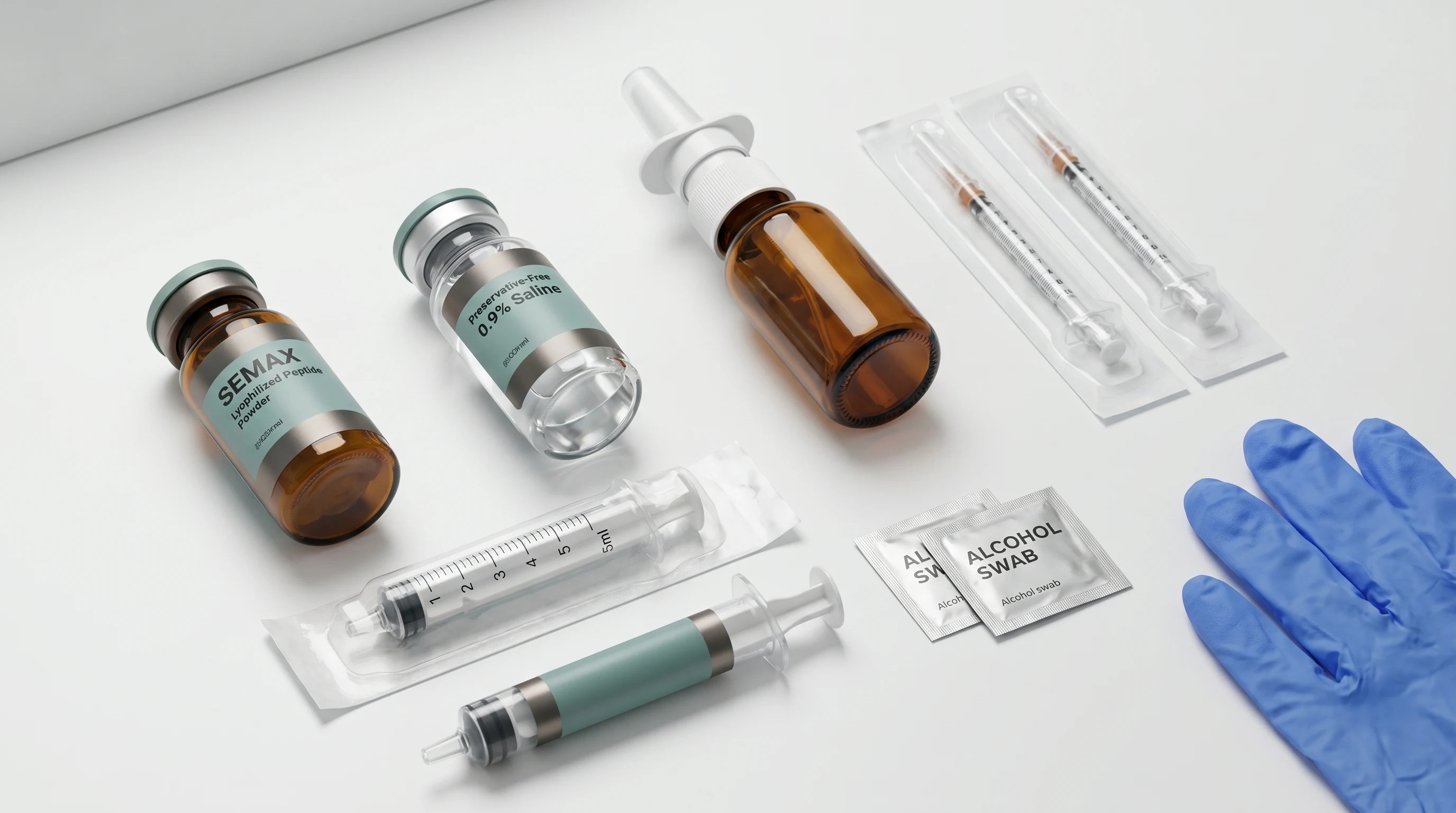
Before starting, gather every item you will need on a clean, flat surface. Working from a complete kit prevents mid-protocol contamination from rummaging through drawers with gloved hands.
- Lyophilized peptide vial — the sealed research compound (Semax, Selank, etc.)
- Preservative-free 0.9% sterile saline — 5 mL or 10 mL vial; do not use BAC water for nasal preparations — benzyl alcohol is irritating and ciliotoxic to the nasal mucosa
- Sterile empty nasal spray bottle — a metered-dose pump bottle, typically 5 mL or 10 mL with a 0.1 mL or 0.05 mL per-spray volume printed on the spec sheet
- Sterile insulin syringes — 1 mL / 100-unit syringes for transferring saline into the peptide vial
- A larger transfer syringe (3 mL or 5 mL with luer lock) — for moving the reconstituted solution from the vial into the nasal bottle
- Alcohol swab pads — 70% isopropyl alcohol for sterilizing every rubber stopper before puncture
- Nitrile gloves — strongly recommended for nasal preparations because the nasal mucosa is more sensitive to skin-oil contamination than subcutaneous tissue
- Permanent marker and labels — for recording the peptide name, concentration, dose-per-spray, and reconstitution date on the bottle
If you are new to reconstitution generally, start with Peptide Reconstitution 101 before attempting a nasal preparation — the technique builds on the same fundamentals.
How Do You Make a Peptide Nasal Spray Step by Step?#
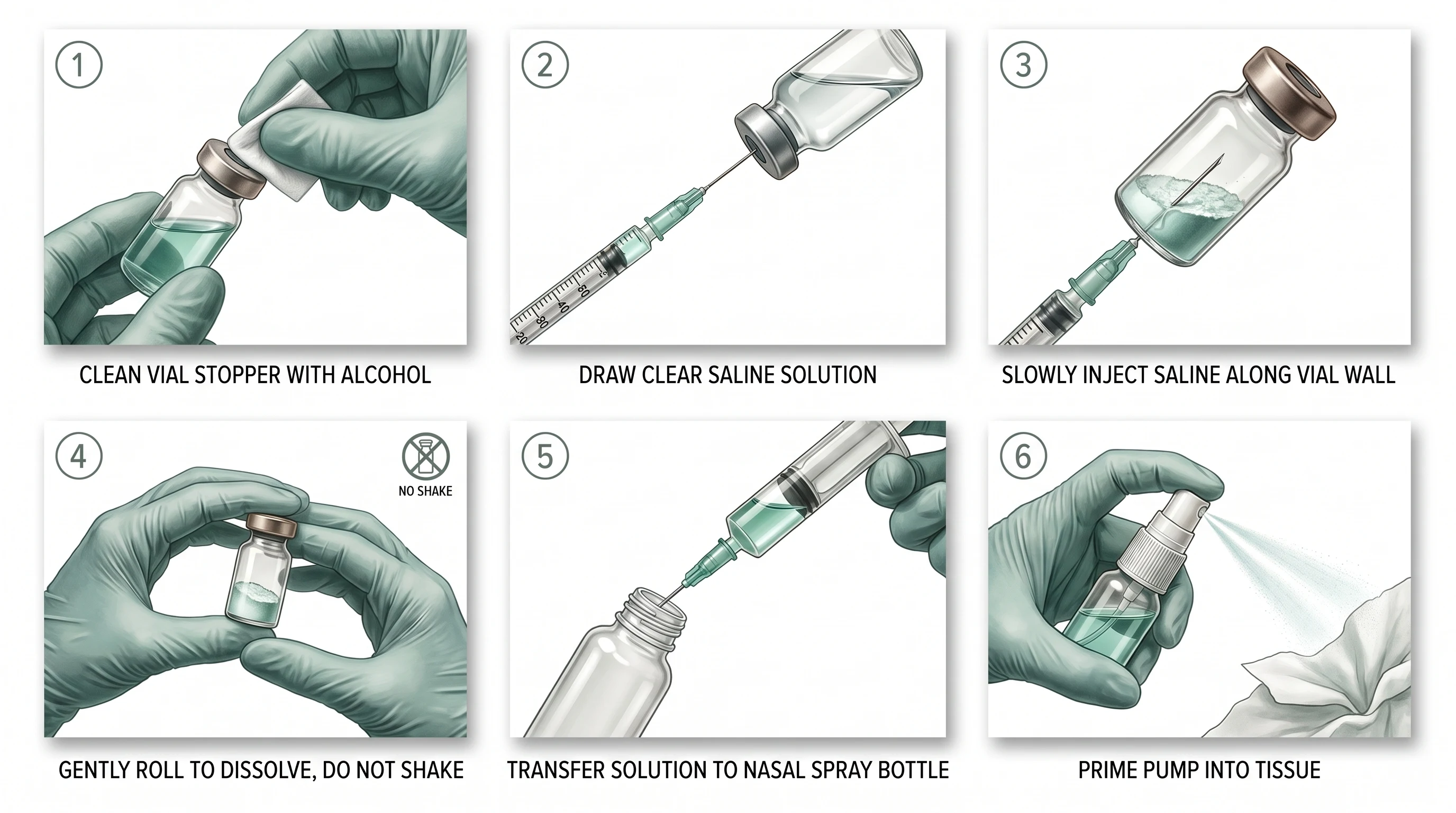
The full preparation is a six-step protocol. Allow the peptide vial and saline to reach room temperature for 5–10 minutes before starting — cold solvent on a cold lyophilized cake takes longer to dissolve and increases the chance of an incomplete mix.
- Sterilize the work surface and your hands. Wipe the surface with 70% isopropyl alcohol and let it dry. Wash your hands and put on nitrile gloves.
- Swab every rubber stopper. Sterilize the lyophilized peptide vial stopper, the saline vial stopper, and (if applicable) the rubber gasket on the empty nasal spray bottle.
- Draw the calculated saline volume into a sterile insulin syringe. Most cognitive-peptide nasal preparations target a 1 mg/mL or 3 mg/mL final concentration — see the dose math section below.
- Inject the saline slowly down the inside wall of the peptide vial. Never blast solvent directly onto the lyophilized cake — the force can fragment peptide chains. Let the vial sit undisturbed for 2–3 minutes.
- Gently roll the vial between your palms until the cake is fully dissolved. Never shake. Cloudiness should clear within 2–5 minutes; if it does not, the peptide may be degraded.
- Transfer the solution into the nasal spray bottle. Use a larger 3 mL or 5 mL syringe to draw the full reconstituted volume out of the original peptide vial and dispense it into the empty nasal bottle. Cap the bottle, then prime the pump by pumping 2–3 times into a tissue until you see a fine, even mist. The bottle is now ready for use.
How Do You Calculate Dose Per Spray?#
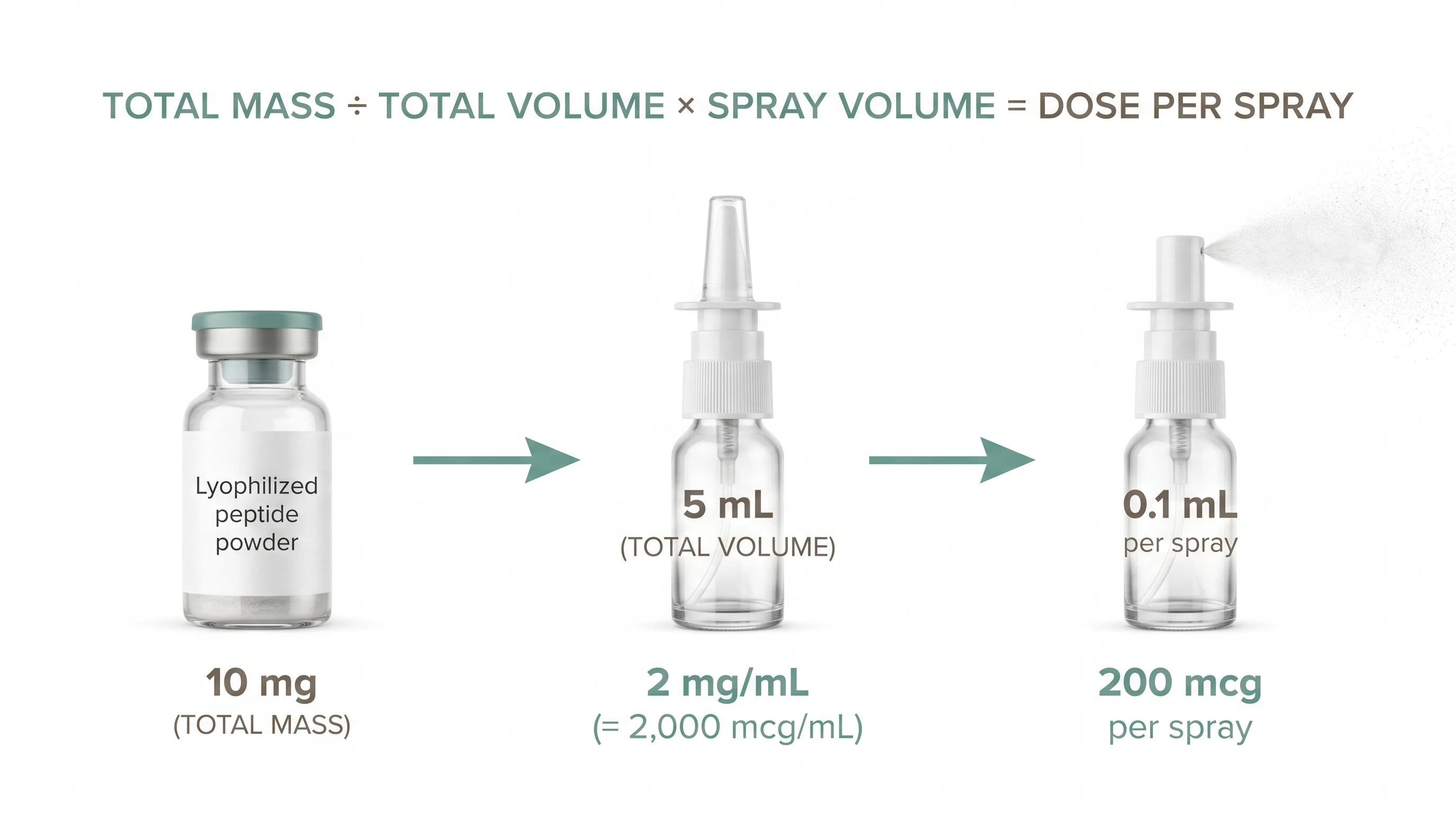
Dose-per-spray is determined by two numbers: the concentration of the reconstituted solution (mass ÷ volume) and the metered spray volume of the pump bottle (printed on the bottle’s spec sheet, typically 0.05 mL or 0.1 mL).
Worked example for Semax:
- 10 mg Semax vial reconstituted in 5 mL of preservative-free saline = 2 mg/mL (2,000 mcg/mL)
- A 0.1 mL metered pump = 200 mcg per spray
- For a 600 mcg cognitive-enhancement protocol, deliver 3 sprays (split across nostrils — e.g., 2 in one, 1 in the other)
Worked example for Selank:
- 5 mg Selank vial reconstituted in 5 mL of saline = 1 mg/mL (1,000 mcg/mL)
- A 0.1 mL metered pump = 100 mcg per spray
- For a 300 mcg anxiety-relief protocol, deliver 3 sprays alternating nostrils
The reconstitution calculator at HowToMixPeptides.com automates this math — input the vial mass, saline volume, and per-spray volume to get exact dose-per-spray instantly. The calculator also shows how many sprays equal a given target dose.
How Should a Peptide Nasal Spray Be Stored?#
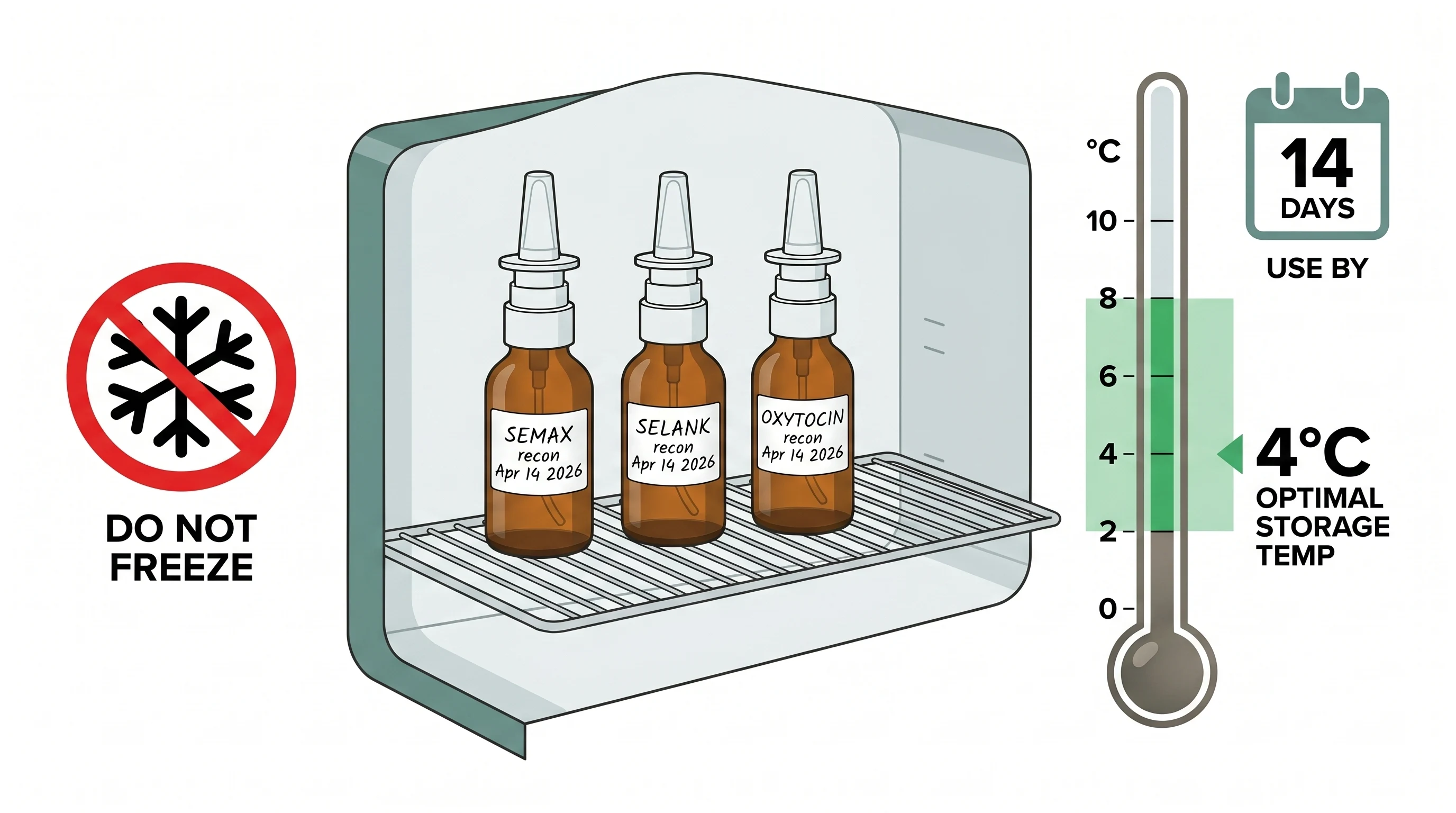
Once filled, the nasal spray bottle should be stored upright at 2–8 °C (36–46 °F) in a standard laboratory or kitchen refrigerator. Most reconstituted peptide nasal sprays remain stable for 10–28 days, with the specific window depending on the peptide:
- Semax / Selank / NA-Semax / NA-Selank: 14–28 days refrigerated
- Oxytocin: 30 days refrigerated (more stable in saline than in BAC water)
- DSIP: 10 days refrigerated — DSIP has limited stability data
- KPV: 14 days refrigerated
- PT-141: 14–28 days refrigerated
Never freeze a reconstituted nasal spray — ice-crystal formation will rupture the peptide bonds and destroy potency. Keep the bottle out of direct sunlight and away from heat sources. Always label the bottle with the peptide name, the reconstitution date, the concentration, and the dose-per-spray. When in doubt, discard and reconstitute fresh — peptides are forgiving until they are not.
What Are Common Nasal Spray Mistakes to Avoid?#
The most frequent error is using bacteriostatic water (BAC water) instead of preservative-free saline. The 0.9% benzyl alcohol in BAC water is fine for subcutaneous injection but is ciliotoxic — it damages the cilia of the nasal epithelium with repeated exposure, causing irritation, burning, and over time reduced absorption. Saline is the correct nasal solvent.
The second most common mistake is failing to prime the pump. A new metered-dose bottle has air in the dip tube; the first 2–3 pumps will deliver less than the calibrated dose. Always prime into a tissue until you see a fine, even mist before counting your first real dose.
Other common errors:
- Tilting the head back too far when spraying — this drains the solution down the throat instead of holding it on the upper nasal mucosa where olfactory transport happens. Keep the head upright or slightly forward.
- Inhaling sharply during the spray — the solution should coat the mucosa, not be inhaled into the lungs. Breathe gently through the nose during and after the spray.
- Using the same nostril repeatedly — alternate nostrils between doses to give the mucosa time to recover and absorb.
- Reusing an old nasal bottle for a different peptide without sterilizing — cross-contamination ruins the new preparation.
- Storing the bottle horizontally — keep it upright so the dip tube stays submerged.
Which Peptides Have Documented Intranasal Protocols?#
PeptideHub’s research library contains documented intranasal protocols for the following compounds. Each peptide page includes published dose ranges, frequency, and reconstitution notes specific to nasal preparation.
Cognitive & Anxiolytic (the primary nasal-spray category)#
- Semax — 300–1500 mcg intranasal; cognitive enhancement, neuroprotection, brain-injury recovery; 0.1% or 1% solution standard
- Selank — 300–600 mcg intranasal; acute anxiety relief, as-needed dosing; nasal spray is the primary published route
- NA-Semax Amidate — 600–1200 mcg intranasal; the amidated, longer-acting Semax variant with extended half-life
- NA-Selank Amidate — 200–500 mcg intranasal; amidated Selank with enhanced absorption and stability
- Adamax — Semax + Selank blend; intranasal protocols for combined cognitive + anxiolytic effect
- Adalank — 150–300 mcg per dose, 2–3x daily; anxiety management blend
- PE-22-28 — 100–300 mcg estimated intranasal; theoretical CNS access route, limited published data
Sleep, Hormonal & Other CNS Targets#
- DSIP (Delta Sleep-Inducing Peptide) — 200–400 mcg intranasal; sleep induction, stress relief, neuroprotection
- Oxytocin — 20–48 IU intranasal; social bonding, PTSD therapy augmentation, sexual function research
- PT-141 (Bremelanotide) — 1–2 mg intranasal; faster onset than injectable for sexual function research
Anti-Inflammatory & Immune#
- KPV — 100–300 mcg intranasal, 2–3x daily; systemic anti-inflammatory; limited data
- Thymogen — registered as a metered-dose nasal spray in Russia for immune support
- VIP (Vasoactive Intestinal Peptide) — 100–200 mcg/day inhalation/intranasal; pulmonary hypertension research
- IllumiNeuro Protocol — multi-peptide cognitive blend with intranasal component
Cross-Reference Reading#
For deeper context on the cognitive-peptide category, see Cognitive Peptide Research and the Nootropic Peptides Guide. For a head-to-head comparison of the two flagship cognitive nasal peptides, see Selank vs Semax.
Safety, Legal Status & Research Disclaimer#
Peptides like Semax and Selank are widely used as registered pharmaceutical nasal sprays in Russia and several CIS countries but are not FDA-approved in the United States or most Western jurisdictions. They are sold as research chemicals, and all dosing protocols described here are drawn from the published clinical literature for laboratory and educational use only. They are not medical advice. The intranasal route in particular has been most thoroughly characterized for Semax and Selank in published Russian clinical trials — for other peptides on the list above, intranasal dosing is supported by a smaller body of preclinical or limited clinical data.
If you are conducting research with these compounds, work in a controlled environment, document every preparation, and follow the dose ranges in the individual peptide reference pages. When in doubt, start at the low end of the published range and observe before scaling.
Frequently Asked Questions#
Can I use bacteriostatic water (BAC water) for a nasal spray?#
No — or at least, you shouldn’t. The 0.9% benzyl alcohol preservative in BAC water is irritating to the nasal mucosa and damages the cilia of the nasal epithelium with repeated exposure. Use preservative-free 0.9% sterile saline instead. BAC water remains the correct solvent for subcutaneous injection.
How long does a peptide nasal spray last?#
Most peptide nasal sprays remain stable for 10–28 days when stored upright at 2–8 °C. Semax, Selank, and the NA-amidated variants typically last 14–28 days; DSIP is shorter at around 10 days; oxytocin nasal preparations can last up to 30 days. Always label the bottle with the reconstitution date.
How many sprays equal a Semax dose?#
It depends on your concentration and the spray volume of your pump bottle. For a typical 10 mg Semax vial reconstituted in 5 mL of saline (= 2 mg/mL) in a 0.1 mL metered pump, each spray delivers 200 mcg — so 3 sprays = 600 mcg, the standard cognitive-enhancement dose. Use the reconstitution calculator for your specific setup.
Should I tilt my head back when spraying?#
No — keep your head upright or slightly tilted forward. Tilting back drains the solution down the throat. The goal is to deposit the spray on the upper nasal mucosa where the olfactory nerve endings are, which means staying upright and breathing gently through the nose during and after the spray.
Can I make a nasal spray from any peptide?#
Not all peptides absorb well intranasally. Cognitive peptides (Semax, Selank, NA-amidated variants) are designed for it, and oxytocin, DSIP, KPV, and PT-141 have documented intranasal protocols. Larger peptides like BPC-157 and TB-500 are typically used subcutaneously because their nasal bioavailability is poor. Check the individual peptide page in the PeptideHub library for delivery-method recommendations.
How do I clean and reuse a nasal spray bottle?#
Sterilize between batches: rinse with sterile water, then with 70% isopropyl alcohol, then with sterile water again to remove residual alcohol. Air-dry completely upside down on a clean surface. For multi-peptide research, dedicate one bottle per compound and label permanently — cross-contamination is the most common cause of unexpected results.
Why do I feel a slight burn or drip?#
A mild cool sensation is normal. A persistent burn usually means you used BAC water instead of saline, or the saline is not pH-balanced. A drip down the throat means you tilted your head back too far during application. Discard any preparation that causes significant irritation.
For research purposes only. All products and information are provided for laboratory and research purposes only. Peptides described here are not FDA-approved for human use in the United States.
